

Research Impact
The Department of English is dedicated to deploying its research expertise to create beneficial impact across industry, public policy, society, culture, the environment, and community well-being. Research within the department has had demonstrable effects on healthcare communication, language and literature education, and legal and corporate discourse, while faculty’s public engagement in the arts and cultural sectors contributes to promoting cross-cultural awareness within and beyond Hong Kong. Here are some insights into the kinds of impact that extend from these research-led collaborations:
Promoting Health, Equity, and Sustainability Through Effective Communication
Prof. James Jia’s health communications research focuses on designing effective public health messaging for the promotion of the HPV vaccine. His recent research was featured in an article published in Pharmacy Times, a clinically-based journal providing practical information pharmacists can use in their everyday practice. His article published in Ming Pao draws on Prof. Jia’s insights regarding the value of integrating linguistic theories in the design of public health communication.
Prof. Esterina Nervino’s research employs corpus-assisted multimodal discourse analysis to investigate sustainability discourse across domains, particularly luxury and financial sectors. Her studies have generated insights that have provided guidance to companies across different sectors on the role of discourse in promoting positive change. Prof. Nervino’s research has been widely shared through invited seminars for market intelligence and internal training and events co-organized with local organisations addressing specific communities, raising awareness about the role of discourse in sustainability initiatives.

Prof. Christoph A. Hafner’s research in the legal writing and oral advocacy skills of novice lawyers, especially those who use English as a second language, has led to the development of video-based professional training videos that are publicly available on YouTube and used by a global audience for the purpose of legal education and training in both academic and professional contexts. Prof. Hafner’s research has had a direct impact on shaping professional practice in law through the organisation of interdisciplinary symposia bringing together legal and language professionals; plenary talks; and multiple contributions to Hong Kong Lawyer, the professional journal of the Law Society of Hong Kong.
Enhancing Digital Literacy and Language and Literature Education in Hong Kong
Prof. Lucy Yu’s research examines how the development of Digital Storytelling (DST) skills amongst pre-service teachers and their students can significantly advance character development, second language acquisition, and digital literacy. Prof. Yu’s work has shown that DST boosts students’ confidence in using diverse digital tools, fosters interest in English language learning, and promotes student-centred, collaborative learning. In an article in The Standard featuring Prof. Yu’s DST pedagogy, students affirm that applying these digital skills boosts their engagement in the learning process.
Extending from his research in second language writing and English for academic purposes, Prof. Ge Lan has built a linguistic model focusing on language use in discipline-specific student writing. Drawing on applied linguistics methodologies, Prof. Lan has developed a portfolio of pedagogical materials that integrate GenAI tools into language teaching and learning and promote critical and collaborative engagement with emerging AI tools with benefits that extend far beyond the classroom.
Prof. Matthew Sung’s research on English as a lingua franca amongst local and international students at Hong Kong universities examines the challenges and opportunities that come with English Medium Instruction in a multilingual city. His insights into linguistic ideologies and linguistic pluralism have been shared on public platforms that shape perceptions and practices of international educators working in diverse linguistic and cultural environments worldwide.
Prof. Klaudia Lee’s research in 19th- and early-20th-century literature and life writing has led to ongoing collaborations with Hong Kong Public Libraries, including a series of public workshops on themes such as memory and the city in literature and creative nonfiction writing. Prof. Lee has created the open access website Experiencing the City as a platform for public engagement activities relating to reading and interpreting urban environments.
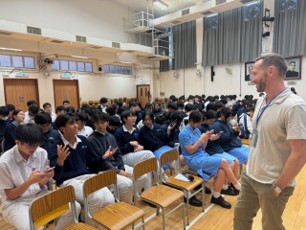
Prof. Eric Sandberg brings his research expertise in modern/postmodern fiction and crime fiction to over 200 students and teachers at Maryknoll Father’s School, sharing strategies with students for selecting appropriate literary and filmic texts for the School Based Assessment portion of the DSE and for developing critical reading skills that enrich learning beyond the classroom.
Prof. Joanna Mansbridge has shared her research interests in ecological theatre-making with students at St. Paul’s College through drama workshops that inspire creative ways to cultivate environmental awareness. She has also delivered workshops for Good Hope School and Confucian Tai Shing Ho Kwok Pui Chun College on Reading Shakespeare in the 21st Century.
Promoting Cross-cultural Awareness
Faculty’s research in literature and the humanities has led to collaborations with cultural organisations in and beyond Hong Kong, including an invited seminar at Tai Kwun’s Summer Institute on ecological methods in international theatre-making; a digital keynote talk with the Singaporean collective T:>Works; a feature on crime fiction for an award-winning British podcast; and the Dickens and Adaptation public symposium, which brought together international literary scholars and artists to discuss transnational engagements with Charles Dickens from the 19th century to the present.
Labs and Networks
Two primary platforms support the department’s commitment to bridging scholarly research with the communities it serves. First, the Professional Communications Lab hosts events that link industry and academia and offers publicly-accessible training videos and executive courses for professionals seeking to enhance their communication strategies within multilingual, intercultural workplaces. Second, the Transnational Urban Narratives Network organises events, reading groups, and workshops that bring together scholars and practitioners in the fields of literature, cultural studies, architecture, and media studies in interdisciplinary dialogues around the meanings and practices of “the urban.”


Conferences
Conferences also serve as a fundamental platform for sharing research and fostering collaborations beyond the academy. At the May 2025 conference AI Literacy in the Legal Context, English Professional Communication and Law faculty from CityUHK met with practicing Hong Kong lawyers to discuss important issues specific to the implementation of AI in legal education. In December 2025, the department hosted the 8th annual International Conference of the Asia-Pacific LSP and Professional Communications Association, bringing academics, industry partners, and institutions into dialogue around the theme “Collaboration, Innovation, and Impact: Bridging Academic and Professional Worlds.” In December 2024, department faculty held the Urban Mediations: International Conference on the Narratives, Ecologies, and Poetics of the City, engaging scholars, artists, and practitioners from across Asia, Europe, and North America in cross-disciplinary conversations on urban transformations from the 19th to the 21st centuries. In June 2026, the department hosted the 7th Asian Shakespeare Association Conference, which explored the physical borders and virtual spaces across which Shakespeare’s works circulate, as well as the symposium, Multidisciplinary Approaches to Language and Health Communication, which brought together researchers and practitioners to address the contextual and cultural sensitivities in health communication. In November 2026, the department will hold the International Symposium on Language Science and Human Well-being, creating an international platform for cutting-edge interdisciplinary research on the pivotal role of language in promoting physiological, psychological, and social well-being and facilitating clinical communication.
